Destination guides
Alphonse Atoll: Fly Fishing Guide
Everything you need to know before fishing Alphonse Island: species, seasons, flies, gear, and what to expect from one of the world's most diverse saltwater fly fishing destinations.

Steve Raath
8 min

Alphonse Island sits roughly 400km southwest of Mahé, deep in the outer islands of the Seychelles. Getting there takes commitment - a flight to Mahé, then a light aircraft transfer that drops you onto an island so remote it feels like the world has been left behind entirely. And in many ways, it has.
What greets you when you arrive is something the Seychelles does better than almost anywhere on earth - pristine, untouched wilderness. The atoll remains as wild as it has always been, the flats unmarked, the water often impossibly clear. What makes Alphonse unique among the outer islands is what sits alongside that wildness - a lodge that has somehow built a world-class experience at the edge of the world. Exceptional food, beautiful accommodation, warm and attentive staff. Considering how far they are from any mainland, what Blue Safari have built on Alphonse is genuinely impressive.
The Fishery

Many of the world's most experienced saltwater fly fishing guides still consider Alphonse the most diverse fly fishery in the Seychelles. That's not a casual claim - it's the considered opinion of people who have fished everywhere.
The reason is simple: the Seychelles Big 5. Bonefish, GT, indo-pacific permit, triggerfish, and milkfish are all realistically in play on Alphonse, often within the same day. Most atolls in the Seychelles are defined by one or two standout species. Alphonse offers the full picture.
What's also unique about Alphonse is that there's always something to do. Many atolls in the Seychelles are heavily tide dependent - certain species only appear in specific windows, and a bad tide can mean a slow period. On Alphonse, each tide level presents its own opportunities across an array of target species.
Bonefish

If Alphonse has a claim to fame, it's the bonefishing - and I'm convinced there is no better bonefish fishery anywhere in the world.
What sets it apart isn't just the numbers, though the numbers are extraordinary. It's the variety of ways you can target them. Large singles cruise the dead low tides - cautious, measuring, testing every cast. Giant shoals of really good size fish push across the sand on the dropping tide, moving quickly and eating with conviction.
Best Flies for Bonefish
Fly wise, the classics remain king.
Pillow Talk - a classic that seldom gets refused.
Golden Knight - the truth is a golden knight can catch pretty much anything out here.
Alphlexo Crab - warmer water can produce some fussy bonefish, but the flexo will get the job done if nothing else is working.
How to Fish for Bonefish around Alphonse
Generally we'll instruct anglers to lead the fish by about 3 feet. Long, slow strips are the play once we think the fish can see the fly. Like all saltwater species, a strip set is necessary.
Giant Trevally

The first question I love to ask guests at tackle setup is what their target species is for the trip. Nine times out of ten, it's GT. That's completely understandable - there is no eat in fly fishing quite like a GT turning on a fly.
Alphonse isn't the most prolific GT atoll in the Seychelles - Cosmoledo, Farquhar, and Providence contend for that title - but it produces quality fishing and, on the right weeks, extraordinary results. We've had weeks with more than 50 fish over 60cm landed across the group. That's serious GT fishing by any standard.
There are several productive ways to target GT around Alphonse and neighboring St. François Atoll:
Poling a grassline on a higher tide presents beautiful opportunities. Fish often follow rays and sharks across these areas, or are free swimming looking for a meal.
Surf walks from dead low are tough work - physically demanding and mentally testing - but deeply rewarding when a GT charges the fly around white water.
Drifting within the lagoon amongst heavy coral boulders can be extremely effective for finding those dream meter-plus fish that hold deeper water and don't show themselves easily.
Hanging around the beach on a high tide and watching for bait is an underrated technique. Big GTs lurk around concentrations of bait, and when they show, the eat can be memorable.
Best Flies for Giant Trevally
On the fly, bucktail remains the dominant material across all of the Seychelles, and for good reason. A hollow-tied bucktail with a few long hackle feathers provides a crisp, wavy profile that remains a favorite among guides.
Bucktail is incredibly light and sheds water beautifully - essential when you're casting a 12 weight all day.
How to Fish for Giant Trevally
When fishing for GT, lead the fish by about two to three rod lengths - 18 to 27 feet. These fish are often residential and they don't appreciate a fly landing close to their heads.
There's also a common misconception about strip speed. Start slow. Leave the fly to sit. Once you get a reaction - once the fish turns and commits - that's when you speed up the strip. Stripping too fast too early is a common mistake that often results in a lackluster reaction from the fish.
Indo-Pacific Permit

There is an incredibly healthy population of Indo-Pacific permit around Alphonse and St. François Atolls. They are also, as any serious angler knows, amongst the most difficult fish on the flats to get to eat.
The most productive locations to target them:
Beaches around the island on a higher tide are consistent hotspots. Permit are often found hanging around shoals of bonefish and mullet.
Highspots around the atoll on high tide will often produce permit, frequently sitting on rays in these areas - one of the most epic sights in saltwater fly fishing.
Depressions around sand flats late in the drop and early in the push can present opportunities for permit on the move.
Best Flies for Indo-Pacific Permit
Light flexo crabs are king. Our preferred setup is a size 2 SL12 hook with two 3mm tungsten beads. Permit eat mid-column, so the fly doesn't need to get all the way to the bottom.
Color wise - tan remains a reliable favorite.
How to Fish for Indo-Pacific Permit
When presenting to permit, cast closer than you might think. Their vision is narrow. Aim within 3 feet of the fish, ideally in front of their eyes. A long, slow strip in front of their face can get their attention - and once you get a reaction, one should speed up the strip to entice an aggressive follow.
Triggerfish

The triggerfish population at Alphonse is one of the healthiest and most abundant I've encountered anywhere in the Seychelles. They can be aggressive feeders. They can also be near impossible. The key, as with most things in fly fishing, is patience - keep making good casts and you'll eventually find a hungry fish and ultimately a day-changer.
The most productive trigger locations:
Coral finger flats are incredibly productive, particularly on neap tides. These rough environments hold resident fish that are often seen tailing and feeding directly on the finger.
Surf walks are a prime trigger move - fish these areas from the beginning of a pushing tide on spring tides and the opportunities can be outstanding.
Best Flies for Triggerfish
Guide creativity with trigger flies has evolved significantly in recent years. Three patterns worth carrying:
Heavier Flexo Crabs - these need to get to the bottom as quickly as possible. Weight is everything with triggers.
Heavy 3D crabs - the realistic profile can drive triggers into a frenzy when presented correctly.
Curly tail shrimps - the flexible materials create wild movement that triggers find difficult to resist.
How to Fish for Triggerfish
When fishing for triggers, a slow presentation is almost always the answer. Cast 3 feet in front of the fish, let the fly sink to the bottom, and once you're confident the fish can see it - a long, slow strip. If you get a reaction, leave the fly completely still. Give the fish every chance to inhale it before doing anything else.
Milkfish
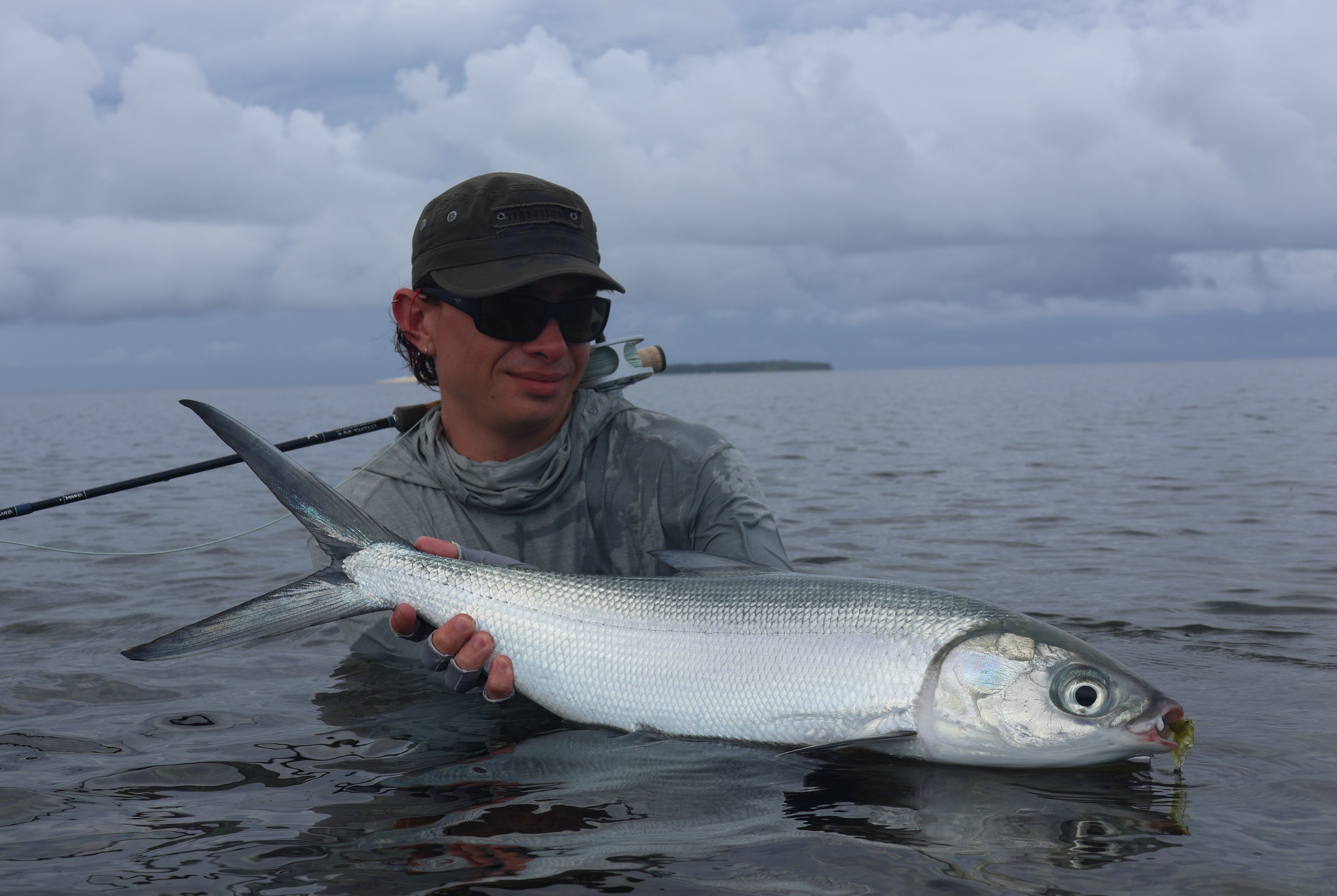
Milkfish are largely found offshore - outside the atoll - and are a perfect first stop as you make your way out to the flats in the morning. Starting a slam hunt with a morning milk is hard to beat.
As guides, we look for large groups of fish feeding along current lines on the surface. They can be difficult to read tide-wise, but the dropping tide consistently produces the best results in our experience.
Best Fly for Milkfish
The fly of choice is the Milky Dream - an algae-imitating pattern that matches the surface matter these fish are feeding on. It doesn't look like a fly that should work, but because of how the fly is weighted it sits perfectly within the feeding line of the milkfish.
How to Fish for Milkfish
The technique is deceptively simple and extraordinarily demanding. Cast right in front of the feeding lines, maintain connection with the fly by using long and very slow strips. The challenge is keeping contact without pulling the fly out of the feeding line of the milkfish - the longer our fly stays within that zone, the greater our chances to get snagged.
Any bump or tension may mean the fish has inhaled the fly, meaning a strong strip set is required.
Rod & Gear Requirements for Alphonse
The ideal setup for Alphonse is three rods - a 9 weight, a 10 weight, and a 12 weight.
9 weight covers bonefish and permit.
10 weight handles milkfish and triggerfish.
12 weight is your GT rod.
Leaders are straightforward:
15lb fluorocarbon for bonefish and permit.
20lb for triggerfish.
20–25lb for milkfish.
100-150lb for GT.
Tropical floating lines only. Temperate lines go limp in the Seychelles heat and will cost you distance and accuracy at the worst possible moment.
When To Go
Alphonse fishes from September through May. Peak season runs October through April. The shoulder months of September and May still produce excellent fishing with slightly more variable conditions.
The prime season closes June through August due to strong south east winds, however, one can still plan trips during this period, and it can be productive fish-wise. It does however require the ability to deal with strong winds whilst fishing.
Getting There
Fly to Mahé. From Mahé, a light aircraft transfer takes approximately 45 minutes to Alphonse. Transfers are coordinated through the lodge and aligned with the weekly fishing schedule. It's a journey - but that's part of what makes Alphonse feel so special when you arrive.
A final word
Alphonse is the destination I recommend first to almost every serious angler who hasn't yet fished the Seychelles. The variety is unmatched, the lodge is exceptional, and the fishing has a consistency that very few destinations in the world can match. Whether you're chasing your first bonefish or hunting a Seychelles Slam, Alphonse gives you every opportunity to make it happen.
Looking to book Alphonse? Contact me here, or send over a WhatsApp message.
